Introduction
Corrosion Under Insulation (CUI) is one of the most severe and costly integrity threats affecting insulated industrial pipelines worldwide. It often develops undetected beneath insulation systems, leading to hidden wall thinning, structural weakening, and unexpected failures.
Industries heavily affected by CUI include:
➤ Oil And Gas
➤ Refineries
➤ Petrochemical Plants
➤ LNG Terminals
➤ Power Plants
➤ Fertilizer And Chemical Facilities
➤ Marine And Offshore Installations
Long Range Ultrasonic Testing (LRUT), also known as Guided Wave Ultrasonic Testing (GWUT), provides a powerful screening solution for detecting potential CUI related wall loss without widespread insulation removal.
What is Corrosion Under Insulation (CUI)?
CUI occurs when moisture penetrates insulation systems and becomes trapped against the pipe surface.
Common causes include:
➤ Damaged cladding
➤ Poor sealing at joints
➤ Wet insulation materials
➤ Chloride contamination
➤ Elevated operating temperatures
➤ Inadequate drainage
Over time, corrosion progresses beneath the insulation layer, often remaining invisible until significant wall loss has occurred.
Why CUI is Difficult to Detect ?
Traditional inspection challenges include:
➤ Insulation must be removed for direct inspection
➤ Extensive scaffolding may be required
➤ Large areas must be opened without knowing exact corrosion location
➤ High labor and material cost
➤ Production disruption
Spot ultrasonic thickness testing is only effective after insulation is removed.
This makes CUI inspection one of the most expensive maintenance activities in industrial plants.
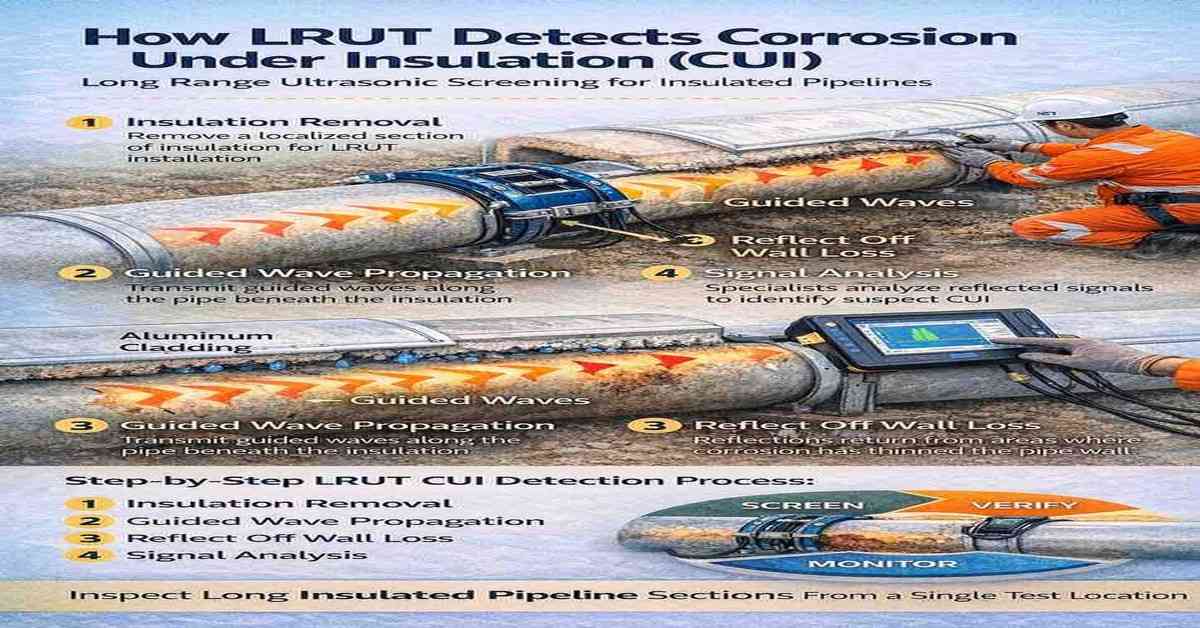
How LRUT Detects CUI ?
Step 1 Localized Insulation Removal at Test Point
A small section of insulation is removed to install the LRUT collar.
Step 2 Guided Wave Propagation
Low-frequency ultrasonic guided waves are transmitted along the pipe wall beneath insulated sections.
Step 3 Reflection from Wall Loss
If corrosion has reduced the pipe wall thickness, the cross-sectional area changes, generating a reflection.
Step 4 Signal Interpretation
Reflections are analyzed and classified to identify suspect corrosion zones.
LRUT enables screening of long insulated pipeline sections from a single access point.
What LRUT Can Identify in CUI Applications ?
LRUT can screen for:
➤ General wall thinning
➤ Localized corrosion
➤ Metal loss beneath insulation
➤ Corrosion at supports
➤ Moisture-prone zones
➤ Degradation at low points
It is important to note:
LRUT is a screening method.
Suspect areas are typically confirmed using localized UT, PAUT, or other verification techniques.
Advantages of Using LRUT for CUI Screening
✔ Minimizes insulation removal
✔ Reduces scaffolding
✔ Covers long pipeline sections
✔ Prioritizes high-risk zones
✔ Reduces inspection cost
✔ Supports risk-based inspection (RBI)
✔ Improves shutdown planning
LRUT transforms CUI inspection from blind removal to targeted verification.
When LRUT is Most Effective for CUI ?
LRUT CUI screening is most effective for:
➤ Long straight aboveground insulated pipelines
➤ Pipe racks
➤ Utility corridors
➤ High-temperature service lines
➤ Aging infrastructure
➤ Large industrial networks
It is particularly useful in:
➤ Refineries
➤ Petrochemical complexes
➤ LNG terminals
➤ Power plants
➤ Offshore topsides
Limitations of LRUT for CUI Detection
Professional transparency is important. LRUT limitations include:
➤ It does not measure exact wall thickness
➤ Signal attenuation may limit range
➤ Complex geometry can affect interpretation
➤ Subsea CUI applications require feasibility evaluation
Proper engineering oversight is essential for reliable results.
Integrating LRUT into a CUI Management Strategy
The most effective CUI strategy includes:
➤ Risk assessment of insulated circuits
➤ LRUT screening for long sections
➤ Identification of high-priority areas
➤ Targeted insulation removal
➤ Localized UT verification
➤ Repair & coating restoration
➤ Repeat monitoring where necessary
This structured approach significantly reduces maintenance cost and downtime.
Engineering Expertise Matters
Successful CUI screening requires:
➤ Proper feasibility studies
➤ Range prediction modeling
➤ Certified Level III interpretation
➤ Structured severity classification
➤ Clear reporting and prioritization
At NDT AND PWHT SOLUTIONS PVT LTD, we provide:
➤ Advanced Piezoelectric LRUT systems
➤ EMAT Guided Wave capability for high-temperature lines
➤ Custom collar solutions
➤ ISO 9712 Certified personnel
➤ Engineering-led methodology
➤ Structured CUI risk prioritization
➤ Global mobilization capability
We operate as a Guided Wave Engineering Specialist, not merely an inspection vendor.
Conclusion
Corrosion Under Insulation remains one of the most significant threats to industrial pipeline integrity. LRUT provides a powerful, cost-effective screening method that enables operators to identify suspect corrosion zones beneath insulation without unnecessary material removal. When integrated into a structured integrity program, LRUT dramatically improves CUI management efficiency and reliability.
🌍 Contact Us – Your Global Pipeline Integrity Partner
NDT AND PWHT SOLUTIONS PVT LTD
Specialists in Long Range Ultrasonic Testing (LRUT) And Guided Wave Pipeline Inspection
📍 Headquartered in India | UAE Operational Support | 🌎 Worldwide Deployment
📧 support@solutionss.org
Speak with our LRUT engineering team to design a structured CUI screening strategy for your insulated pipeline systems.