Introduction
Modern industrial facilities operate complex pipeline systems that require structured inspection strategies to maintain safety and reliability. Traditional inspection programs often rely on fixed inspection intervals, which may not accurately reflect the real condition of assets.
To address this challenge, many industries have adopted Risk Based Inspection (RBI) methodologies based on standards such as:
➤ API 580 – Risk-Based Inspection
➤ API 581 – RBI Technology
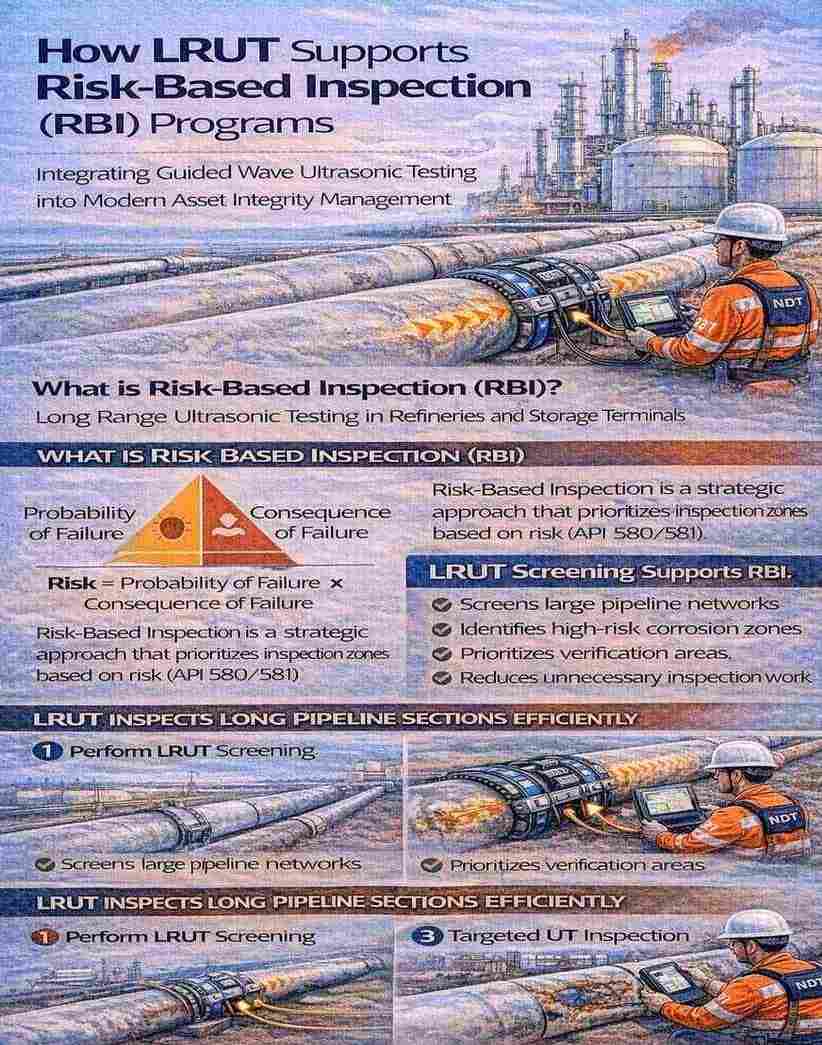
RBI programs prioritize inspection activities based on probability of failure and consequence of failure. Long Range Ultrasonic Testing (LRUT) plays an important role in RBI strategies by providing efficient screening of large pipeline sections and helping asset integrity teams identify high-risk areas.
What is Risk-Based Inspection (RBI)?
Risk-Based Inspection is a structured methodology used to determine where and how often inspections should occur. The goal of RBI is to focus inspection resources on equipment with the highest risk, rather than inspecting all assets equally.
Risk is typically calculated as:
Risk = Probability of Failure × Consequence of Failure
Where:
➤ Probability of failure depends on corrosion rate, material degradation, and operating conditions
➤ Consequence of failure considers safety, environmental impact, and production loss
Challenges in Traditional Inspection Programs
Without RBI and screening technologies, inspection programs often face several issues:
➤ Large pipeline networks with limited inspection coverage
➤ High inspection costs
➤ Excessive insulation removal
➤ Limited shutdown windows
➤ Incomplete understanding of corrosion risk
These challenges make it difficult to prioritize inspection effectively
Role of LRUT in Risk-Based Inspection
Long Range Ultrasonic Testing is an ideal screening tool for supporting RBI programs because it allows inspection of long pipeline sections quickly and efficiently.
LRUT helps integrity teams by:
➤ Screening large pipeline networks
➤ Identifying suspect corrosion zones
➤ Prioritizing areas for detailed inspection
➤ Reducing unnecessary inspection work
Instead of randomly selecting pipelines, LRUT allows operators to focus on the highest-risk areas first.
How LRUT Improves Probability of Failure Assessment?
RBI relies heavily on accurate assessment of pipeline condition.
LRUT improves probability of failure evaluation by detecting:
➤ Metal loss
➤ Corrosion under insulation (CUI)
➤ Erosion
➤ Corrosion near supports
➤ Wall thinning
➤ Unknown degradation zones
These findings help integrity engineers update corrosion rate models and failure probability calculations.
Efficient Screening of Large Pipeline Networks
One of the biggest advantages of LRUT is its ability to inspect long pipeline sections from a single location.
This provides major advantages for RBI programs:
➤ Faster screening coverage
➤ Reduced inspection cost
➤ Minimal insulation removal
➤ Lower scaffolding requirements
➤ Improved planning during shutdowns
For large facilities such as refineries, LNG terminals, and petrochemical plants, LRUT can screen hundreds of meters of pipeline efficiently.
Supporting Targeted Follow Up Inspections
LRUT does not replace detailed inspection methods such as conventional UT or PAUT. Instead, it supports them.
Typical RBI workflow using LRUT:
➤ Perform LRUT screening across pipeline circuits
➤ Identify suspect reflection indications
➤ Classify indications by severity (High / Medium / Low)
➤ Perform localized UT verification where required
➤ Update risk ranking and inspection intervals
This structured approach improves overall inspection effectiveness
Benefits of Integrating LRUT into RBI Programs
➤ Efficient inspection of large pipeline networks
➤ Improved corrosion detection
➤ Reduced inspection cost
➤ Better prioritization of maintenance activities
➤ Improved shutdown planning
➤ Enhanced asset integrity management
These benefits make LRUT an important tool for modern inspection programs.
Engineering Expertise is Essential
Successful integration of LRUT into RBI programs requires engineering expertise. Factors such as pipeline geometry, coating condition, supports, and temperature can affect guided wave propagation.
At IAIS India PVT LTD, we support RBI programs through:
➤ LRUT feasibility studies
➤ Range prediction modeling
➤ Signal interpretation by certified Level III engineers
➤ Corrosion severity classification
➤ Structured inspection reporting
➤ Global mobilization capability
Our engineering approach ensures reliable results for asset integrity teams.
Conclusion
Risk-Based Inspection programs are designed to focus inspection efforts where they are needed most. Long Range Ultrasonic Testing supports this strategy by providing rapid screening of large pipeline networks and identifying potential corrosion zones early. By integrating LRUT into RBI programs, industrial operators can improve safety, reduce inspection costs, and enhance long-term asset reliability.
🌍 Contact Us Your Global Pipeline Integrity Partner
IAIS India PVT LTD
Specialists in Long Range Ultrasonic Testing (LRUT) & Guided Wave Pipeline Inspection
📍 Headquartered in India | UAE Operational Support | 🌎 Worldwide Deployment
📧 i@iaisindia.com
Speak with our LRUT engineering team to design a structured and mistake-free LRUT inspection program.