Introduction
Pipeline operators face a major challenge when inspecting long pipeline networks: how to detect corrosion effectively while controlling inspection costs.
Traditional inspection methods often rely on large-scale excavation programs, which involve exposing long pipeline sections to perform localized thickness measurements. While excavation-based inspections provide direct access to the pipe surface, they are expensive, time-consuming, and operationally disruptive.
Long Range Ultrasonic Testing (LRUT) offers a modern screening approach that allows operators to evaluate long sections of pipeline from a single location, dramatically reducing inspection costs. This article compares the costs and operational impact of LRUT screening versus large-scale excavation inspection programs.
Traditional Excavation Based Pipeline Inspection
In conventional inspection programs, operators often perform:
➤ Pipeline excavation
➤ Insulation removal
➤ Surface cleaning
➤ Localized ultrasonic thickness testing
➤ Coating inspection
➤ Reburial and restoration
These inspections typically occur in areas where corrosion is suspected or required by maintenance programs.
Cost Drivers in Excavation Programs
Excavation inspection costs are influenced by several factors:
🔹 Civil Work
Excavation equipment, trenching, and soil removal.
🔹 Labor
Large inspection teams and extended field work.
🔹 Surface Restoration
Reinstating soil, pavement, or landscaping.
🔹 Insulation Removal and Reinstallation
Especially expensive for insulated pipelines.
🔹 Environmental Protection
Required for sensitive areas such as waterways or urban locations.
🔹 Shutdown or Production Impact
Operational disruption during inspection.
These factors can make excavation-based inspection extremely costly for large pipeline networks.
What is LRUT Screening?
Long Range Ultrasonic Testing (LRUT) is a screening technology that uses guided ultrasonic waves to inspect long pipeline sections from a single access point.
Instead of excavating large areas, LRUT identifies potential corrosion zones that require further inspection. The technology allows operators to screen tens of meters of pipeline in both directions from one installation location.
Cost Advantages of LRUT Screening
LRUT significantly reduces inspection costs by:
➤ Eliminating unnecessary excavation
➤ Reducing insulation removal
➤ Minimizing scaffolding requirements
➤ Reducing labor hours
➤ Covering long pipeline sections quickly
➤ Allowing targeted follow-up inspections
This screening approach enables integrity teams to focus only on high-risk areas.
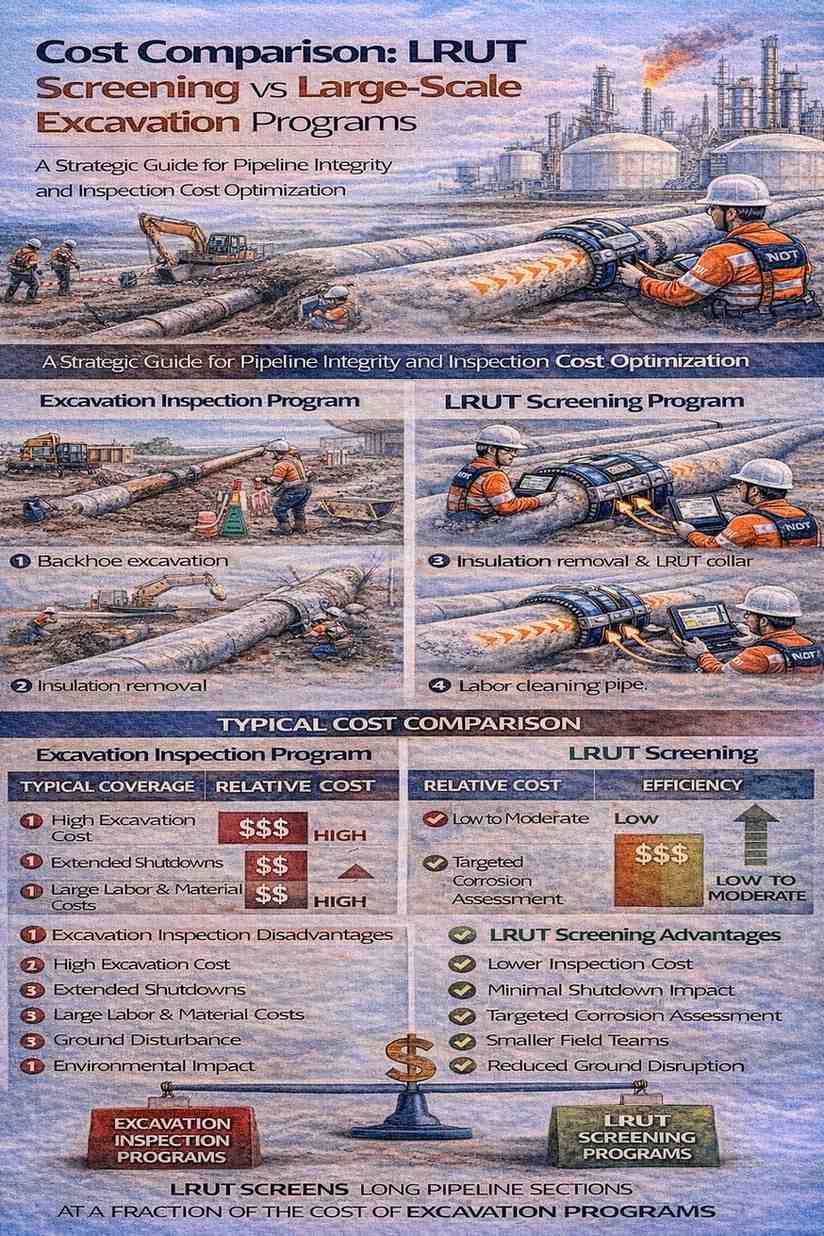
Typical Cost Comparison
While exact costs vary by project, a simplified comparison illustrates the difference.
| Inspection Method | Typical Coverage | Relative Cost | Efficiency |
| Excavation Inspection | Small localized areas | High | Low |
| LRUT Screening | Long pipeline sections | Low to Moderate | High |
LRUT allows operators to screen large pipeline networks at a fraction of the cost of large excavation programs.
Operational Advantages of LRUT
Beyond cost reduction, LRUT provides additional operational benefits:
✔ Faster Inspection Campaigns
Large pipeline sections can be inspected quickly.
✔ Reduced Environmental Impact
Less ground disturbance and excavation.
✔ Improved Shutdown Planning
Screening before shutdown helps prioritize repair work.
✔ Better Risk Prioritization
High-risk corrosion zones are identified early.
✔ Increased Safety
Reduced field exposure for inspection teams.
How LRUT and Excavation Work Together
LRUT does not replace excavation inspections entirely. Instead, it improves inspection efficiency.
A typical workflow includes:
1 LRUT screening of pipeline sections
2 Identification of suspect corrosion zones
3 Targeted excavation at high-risk locations
4 Localized UT verification
5 Maintenance or repair actions
This approach reduces unnecessary excavation and improves inspection accuracy.
Industries That Benefit from LRUT Cost Optimization
LRUT screening programs provide major cost advantages in:
➤ Oil & Gas transmission pipelines
➤ Refineries and petrochemical plants
➤ LNG terminals
➤ Tank farms and storage terminals
➤ Industrial utility corridors
➤ Power plant pipeline networks
➤ Water transmission infrastructure
These industries often operate large pipeline systems where excavation programs would otherwise be extremely expensive.
Engineering Expertise Matters
Effective LRUT screening requires proper engineering planning.
At IAIS India PVT LTD, we support pipeline operators through:
✔ LRUT feasibility studies
✔ Range prediction modeling
✔ Technology selection (Piezoelectric or EMAT)
✔ Certified signal interpretation
✔ Structured severity classification
✔ Detailed inspection reporting
✔ Global mobilization capability
Our engineering-driven approach ensures reliable screening results and cost-efficient inspection programs.
Conclusion
Large-scale excavation inspection programs can be extremely expensive and operationally disruptive.
Long Range Ultrasonic Testing (LRUT) provides a cost-effective screening solution that allows pipeline operators to identify corrosion risks quickly and prioritize targeted inspections.
By integrating LRUT into inspection strategies, operators can significantly reduce maintenance costs while improving pipeline integrity management.
🌍 Contact Us Your Global Pipeline Integrity Partner
IAIS India PVT LTD
Specialists in Long Range Ultrasonic Testing (LRUT) & Guided Wave Pipeline Inspection
📍 Headquartered in India | UAE Operational Support | Worldwide Deployment
📧 i@iaisindia.com
Speak with our engineering team to design a cost-efficient LRUT screening program for your pipeline network.