Introduction
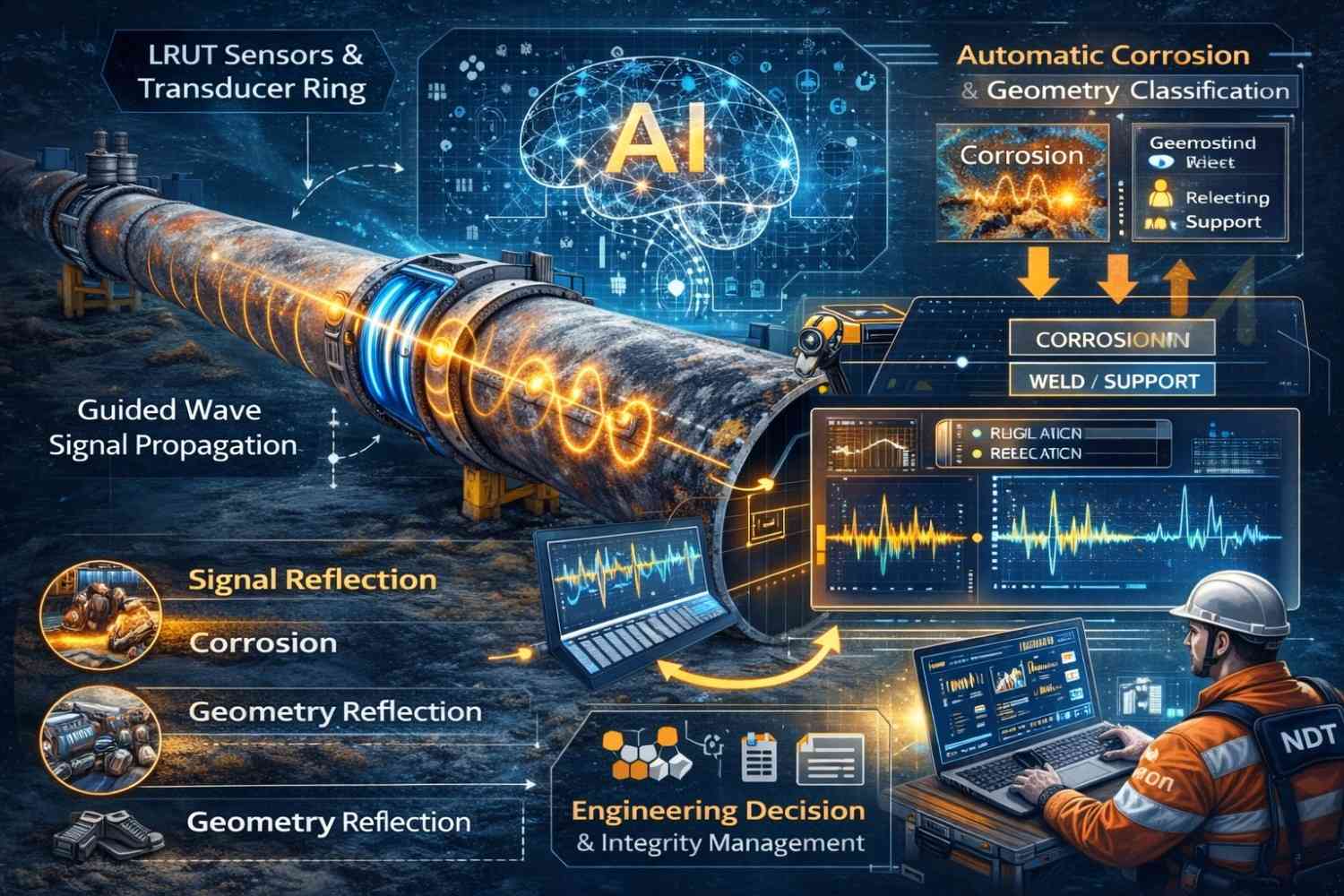
Long Range Ultrasonic Testing (LRUT), also known as Guided Wave Ultrasonic Testing (GWUT), is a powerful non-destructive testing method used to screen long sections of pipelines for corrosion and structural defects.
However, interpreting guided wave signals can be complex because reflections may originate from:
➤ Pipeline geometry
➤ Welds and supports
➤ Attachments and clamps
➤ Corrosion and metal loss
Traditionally, signal interpretation has relied on experienced engineers. Today, artificial intelligence (AI) and advanced signal processing technologies are transforming the way guided wave inspection data is analyzed.
These technologies improve defect detection accuracy, reduce interpretation time, and enhance the reliability of pipeline integrity assessments.
Why Signal Interpretation is Challenging in LRUT?
Guided waves propagate along pipelines and reflect when they encounter changes in cross-sectional area.
The challenge is that many features produce similar signals, including:
➤ Weld reflections
➤ Pipe supports
➤ Geometry changes
➤ Corrosion or wall loss
Distinguishing between these signals requires expertise and careful analysis. Large inspection campaigns may generate thousands of signal traces, making manual interpretation time-consuming.
This is where artificial intelligence and advanced signal processing techniques become valuable.
Role of Signal Processing in LRUT
Signal processing is used to analyze ultrasonic wave data and extract meaningful information.
Modern LRUT systems use advanced signal processing to:
➤ Filter noise from raw signals
➤ Enhance reflection patterns
➤ Identify wave modes
➤ Improve signal clarity
➤ Measure signal attenuation
These techniques help inspectors identify corrosion indications more accurately.
Artificial Intelligence in Guided Wave Inspection
Artificial intelligence algorithms can analyze large volumes of guided wave data and recognize patterns that indicate corrosion or structural anomalies.
AI systems can be trained using historical inspection datasets to learn the difference between:
➤ Geometry reflections
➤ Structural attachments
➤ Corrosion signals
➤ Signal attenuation effects
This allows automated detection of potential defects.
Machine Learning for Defect Recognition
Machine learning models can improve LRUT analysis through:
🔹 Pattern Recognition
Algorithms identify recurring signal patterns associated with corrosion.
🔹 Automated Classification
Signals can be categorized into risk levels such as high, medium, or low severity.
🔹 Anomaly Detection
Machine learning can detect unusual signal signatures that may indicate new defects.
🔹 Continuous Learning
Systems improve accuracy as more inspection data becomes available.
Benefits of AI Assisted LRUT Interpretation
Integrating artificial intelligence into guided wave inspection provides several advantages:
✔ Faster signal analysis
✔ Improved defect detection accuracy
✔ Reduced interpretation errors
✔ Efficient analysis of large datasets
✔ Improved inspection consistency
✔ Better decision support for engineers
These benefits make AI-based signal analysis increasingly valuable for large pipeline networks.
Digital Pipeline Integrity Management
Artificial intelligence also supports the development of digital pipeline integrity platforms.
These platforms integrate:
➤ Inspection data
➤ Historical records
➤ Corrosion monitoring
➤ Risk-based inspection models
➤ Predictive maintenance analytics
By combining LRUT data with AI analytics, operators can build a digital twin of pipeline integrity.
Future Innovations in AI-Based LRUT
Emerging research and development efforts are exploring new technologies including:
➤ Deep learning algorithms for guided wave signals
➤ Automated corrosion detection systems
➤ Cloud-based inspection databases
➤ Real-time signal interpretation tools
➤ AI-assisted inspection planning
These innovations may significantly improve inspection efficiency in the future.
Engineering Expertise Still Matters
Although artificial intelligence enhances signal analysis, human expertise remains essential. AI tools assist engineers, but final interpretation must still be validated by experienced professionals.
At IAIS India PVT LTD, our guided wave inspection services combine:
✔ Advanced LRUT technology
✔ Experienced Level I / II / III inspection engineers
✔ Engineering-based signal interpretation
✔ Advanced analysis techniques
✔ Global inspection experience
This ensures reliable and accurate pipeline integrity assessments.
Conclusion
Artificial intelligence and advanced signal processing are transforming the field of guided wave ultrasonic testing. These technologies enhance defect detection, accelerate data analysis, and support smarter pipeline integrity management. While AI improves inspection capabilities, expert engineering interpretation remains essential to ensure reliable results.
As inspection technology continues to evolve, the integration of LRUT, AI, and digital analytics will play an increasingly important role in protecting pipeline infrastructure worldwide.
🌍 Contact Us Your Global Pipeline Integrity Partner
IAIS India PVT LTD
Specialists in Long Range Ultrasonic Testing (LRUT) & Guided Wave Pipeline Inspection
📍 Headquartered in India | UAE Operational Support | 🌎 Worldwide Deployment
📧 i@iaisindia.com
Contact our engineering team to learn how advanced LRUT technology can support your pipeline integrity program.