Introduction
Large industrial facilities and transmission operators often manage hundreds of kilometers of interconnected pipelines. Conducting isolated inspections line-by-line is inefficient, expensive, and difficult to manage strategically.
An effective Long Range Ultrasonic Testing (LRUT) screening campaign provides structured, large-scale corrosion screening while optimizing cost, time, and risk prioritization.
Designing a successful LRUT campaign requires engineering planning — not just equipment deployment.
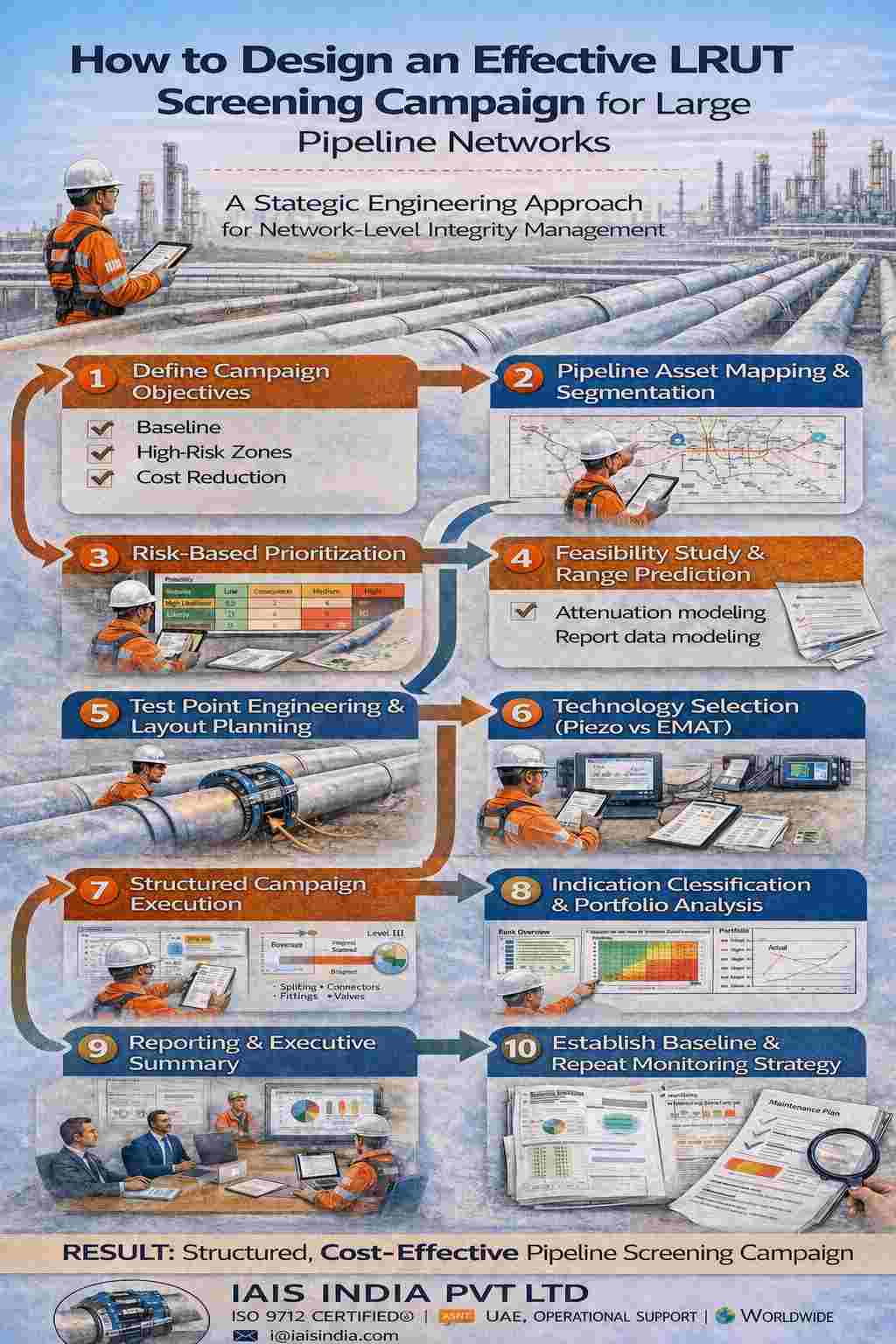
Step 1 – Define Campaign Objectives
Before mobilization, clearly define:
➤ Are you establishing baseline integrity?
➤ Are you targeting high-risk circuits?
➤ Are you supporting Risk-Based Inspection (RBI)?
➤ Is this a pre-shutdown screening?
➤ Is it regulatory compliance-driven?
➤ Is it cost reduction-driven?
Clear objectives define scope and execution strategy.
Step 2 – Pipeline Asset Mapping And Segmentation
Large pipeline networks must be segmented logically.
Categorize pipelines based on:
➤ Diameter range
➤ Material
➤ Coating type
➤ Insulation presence
➤ Temperature
➤ Corrosion history
➤ Accessibility
➤ Support density
➤ Criticality
Segmentation prevents random inspection and ensures engineering prioritization.
Step 3 – Risk Based Prioritization
Not all pipelines require equal inspection frequency.
Prioritize based on:
➤ High Consequence Areas (HCA)
➤ CUI-prone circuits
➤ Corrosion history
➤ Age of pipeline
➤ Operating temperature
➤ Fluid composition
➤ Mechanical stress zones
LRUT works best when aligned with structured risk ranking.
Step 4 – Feasibility Study And Range Prediction
Before field deployment:
➤ Conduct attenuation modeling
➤ Assess coating damping
➤ Evaluate geometry impact
➤ Determine test point spacing
➤ Select appropriate technology (Piezo or EMAT)
➤ Estimate coverage per location
Feasibility planning prevents signal loss and incomplete coverage.
Step 5 – Test Point Engineering And Layout Planning
Proper test point placement determines inspection success.
Key considerations:
➤ Avoid heavy geometry zones
➤ Optimize bi-directional coverage
➤ Overlap scan zones where necessary
➤ Plan safe access points
➤ Coordinate with operations team
➤ Align with shutdown windows (if required)
Poor test point planning is a common reason for campaign inefficiency.
Step 6 – Technology Selection (Piezo vs EMAT)
Select technology based on:
➤ Temperature conditions
➤ Coating type
➤ Surface condition
➤ Geometry complexity
➤ Access constraints
For example:
➤ Ambient pipelines → Piezoelectric LRUT
➤ High-temperature pipelines → EMAT LRUT
➤ Coated / rough surfaces → EMAT preferred
Engineering-led selection ensures optimal performance.
Step 7 – Structured Campaign Execution
During field operations:
➤ Deploy certified Level I / II technicians
➤ Maintain Level III engineering oversight
➤ Use standardized inspection protocol
➤ Document coverage systematically
➤ Classify indications (High / Medium / Low)
➤ Maintain data traceability
➤ Archive raw signal data
Consistency across sites is critical in network campaigns.
Step 8 – Indication Classification & Portfolio Analysis
After screening:
➤ Consolidate indication tables
➤ Rank severity
➤ Identify high-risk clusters
➤ Recommend targeted verification
➤ Develop maintenance action plan
➤ Update Integrity Management Plan (IMP)
A campaign is successful only if it leads to actionable decisions.
Step 9 – Reporting & Executive Summary
For large pipeline networks, reporting should include:
➤ Master inspection overview
➤ Line-by-line indication summary
➤ Coverage statistics
➤ Risk heat map
➤ Budget optimization recommendation
➤ Follow-up verification roadmap
Executive-level reporting supports decision-makers.
Step 10 – Establish Baseline & Repeat Monitoring Strategy
An effective campaign includes:
➤ Baseline documentation
➤ Scheduled repeat inspections
➤ Trend comparison
➤ Degradation rate assessment
➤ Integrity reclassification
This converts LRUT from one-time screening into long-term asset management.
Common Pitfalls in Large LRUT Campaigns
Avoid:
➤ Skipping feasibility studies
➤ Random line selection
➤ No prioritization strategy
➤ Insufficient engineering review
➤ Poor documentation structure
➤ Lack of trending plan
Engineering oversight prevents these failures.
Why Engineering-Led Campaign Design Matters
At IAIS India PVT LTD, we provide:
✔ Full feasibility analysis
✔ Range prediction modeling
✔ Risk-based prioritization
✔ Piezo + EMAT technology selection
✔ Custom collar engineering (1.5”–72”+)
✔ ISO 9712 Level I / II / III certified personnel
✔ Structured severity classification
✔ Network-level reporting capability
✔ Global mobilization support
We function as a Guided Wave Engineering Partner, not just an inspection contractor.
Conclusion
An effective LRUT screening campaign is not simply about running equipment across multiple pipelines.
It requires:
➤ Engineering planning
➤ Risk prioritization
➤ Technology selection
➤ Structured execution
➤ Accurate signal interpretation
➤ Professional reporting
➤ Long-term monitoring integration
When properly designed, LRUT campaigns significantly reduce cost while improving safety and asset reliability across large pipeline networks.
🌍 Contact Us – Your Global Pipeline Integrity Partner
IAIS India PVT LTD
Specialists in Long Range Ultrasonic Testing (LRUT) & Guided Wave Pipeline Inspection
📍 Headquartered in India | UAE Operational Support | 🌎 Worldwide Deployment
📧 i@iaisindia.com
Speak with our LRUT engineering team to design a structured and cost-effective screening campaign for your pipeline network.