Introduction
Liquefied Natural Gas (LNG) terminals are among the most technically demanding industrial facilities in the energy sector. They operate under strict safety regulations and handle cryogenic fluids, high-pressure gas systems, and complex aboveground transfer pipelines.
Maintaining pipeline integrity in LNG terminals is critical to:
➤ Prevent hydrocarbon leaks
➤ Avoid environmental incidents
➤ Ensure operational continuity
➤ Comply with regulatory requirements
➤ Protect personnel and infrastructure
Corrosion remains one of the most significant threats to LNG pipeline systems and this is where Long Range Ultrasonic Testing (LRUT) plays a strategic role.
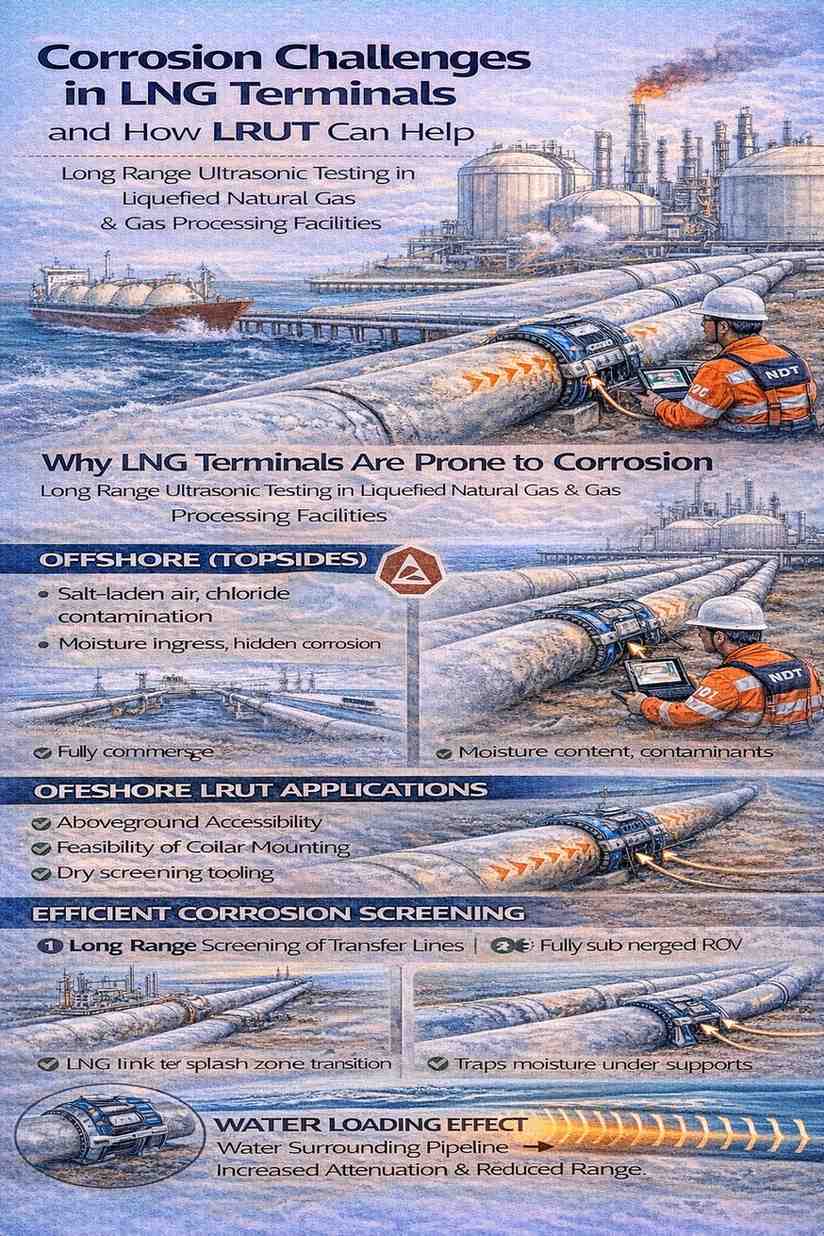
Why LNG Terminals Are Prone to Corrosion?
LNG facilities operate in unique conditions that accelerate degradation mechanisms.
🔹 Marine And Coastal Exposure
Most LNG terminals are located near coastlines, exposing pipelines to:
➤ Salt-laden atmosphere
➤ High humidity
➤ Chloride contamination
🔹 Corrosion Under Insulation (CUI)
Insulated LNG pipelines, especially in high-temperature gas processing areas, are vulnerable to:
➤ Moisture ingress
➤ Insulation damage
➤ Hidden wall thinning
🔹 Thermal Cycling
Temperature fluctuations between cryogenic storage and high-temperature process lines can cause:
➤ Coating degradation
➤ Fatigue-related cracking
➤ Oxidation
🔹 High Pressure Gas Systems
Internal corrosion risks increase due to:
➤ Moisture content
➤ CO₂ or H₂S presence
➤ Contaminants in gas streams
🔹 Support And Clamp Corrosion
Structural supports often trap moisture and promote localized corrosion.
The Inspection Challenge in LNG Facilities
Traditional inspection methods face limitations:
➤ Insulation removal is expensive and time-consuming
➤ Access may require scaffolding
➤ Shutdown windows are limited
➤ Large pipeline networks are difficult to inspect fully
➤ Cryogenic zones require special safety considerations
Blind insulation removal is inefficient and costly. A screening-based approach is more effective.
LRUT Supports LNG Terminal Integrity
Long Range Ultrasonic Testing (LRUT) provides long-distance screening of aboveground pipelines from minimal access points.
🔹 Long-Range Screening of Transfer Lines
Efficient coverage of long LNG transfer corridors.
🔹 Corrosion Under Insulation (CUI) Screening
Identification of suspect wall-loss zones beneath insulation.
🔹 Support & Attachment Assessment
Detection of potential corrosion near supports and clamps.
🔹 Risk-Based Inspection Support
Helps prioritize verification zones based on severity classification.
🔹 Minimal Operational Disruption
Reduces need for extensive scaffolding and insulation removal.
Where LRUT Is Most Effective in LNG Terminals
LRUT is particularly effective for:
➤ Aboveground transfer pipelines
➤ Inter-unit gas lines
➤ Utility pipe racks
➤ Insulated process pipelines
➤ Aging LNG infrastructure
➤ Transition sections (buried-to-aboveground)
➤ Compressor station piping
It provides rapid screening coverage across large pipeline networks.
EMAT LRUT for High-Temperature LNG Systems
Some LNG process lines operate at elevated temperatures.
EMAT Guided Wave LRUT technology offers:
➤ Inspection without liquid couplant
➤ Suitability for high-temperature pipelines
➤ Reduced surface preparation
➤ Enhanced safety in sensitive environments
This expands inspection capability beyond conventional systems.
Integrating LRUT into LNG Integrity Management
An effective LNG inspection strategy includes:
➤ 1 Risk assessment of pipeline circuits
➤ 2 LRUT screening campaign
➤ 3 Indication classification (High / Medium / Low)
➤ 4 Targeted localized UT verification
➤ 5 Maintenance action planning
➤ 6 Baseline documentation
➤ 7 Repeat monitoring strategy
This approach reduces cost and improves safety.
Engineering Led Approach – IAIS India PVT LTD
At IAIS India PVT LTD, we provide:
➤ Advanced Piezoelectric LRUT systems
➤ EMAT high-temperature capability
➤ Custom collar engineering (1.5”–72”+)
➤ ISO 9712 Certified Level I / II / III personnel
➤ Engineering-led feasibility studies
➤ Structured severity classification
➤ Network-level reporting
➤ Global mobilization capability
We operate as a Guided Wave Engineering Specialist, ensuring technically reliable LNG pipeline screening.
Benefits of LRUT in LNG Terminals
➤ Reduced insulation removal
➤ Faster inspection coverage
➤ Lower inspection cost
➤ Improved risk prioritization
➤ Enhanced shutdown planning
➤ Improved compliance readiness
➤ Long-term monitoring capability
Conclusion
LNG terminals face complex corrosion challenges driven by marine exposure, CUI risk, high pressure, and thermal cycling. Long Range Ultrasonic Testing (LRUT) provides an efficient, engineering-driven screening solution that helps operators detect potential corrosion zones early while minimizing operational disruption.
When integrated into a structured integrity management program, LRUT significantly enhances pipeline safety and reliability in LNG facilities.
🌍 Contact Us Your Global Pipeline Integrity Partner
IAIS India PVT LTD
Specialists in Long Range Ultrasonic Testing (LRUT) & Guided Wave Pipeline Inspection
📍 Headquartered in India | UAE Operational Support | 🌎 Worldwide Deployment
📧 i@iaisindia.com
Speak with our LRUT engineering team to design a corrosion screening strategy for your LNG terminal pipelines.