
Introduction
Offshore and subsea pipelines are among the most critical and challenging assets in the oil & gas industry. These pipelines operate under extreme environmental conditions, including hydrostatic pressure, marine growth, saltwater exposure, and complex structural configurations.
While Long Range Ultrasonic Testing (LRUT) is widely used for aboveground pipeline screening, its offshore and subsea applications require careful feasibility evaluation and engineering planning.
This article explains:
➤ Where offshore LRUT is practical
➤ When subsea LRUT is feasible
➤ Engineering limitations
➤ Deployment strategies
➤ Best practice considerations
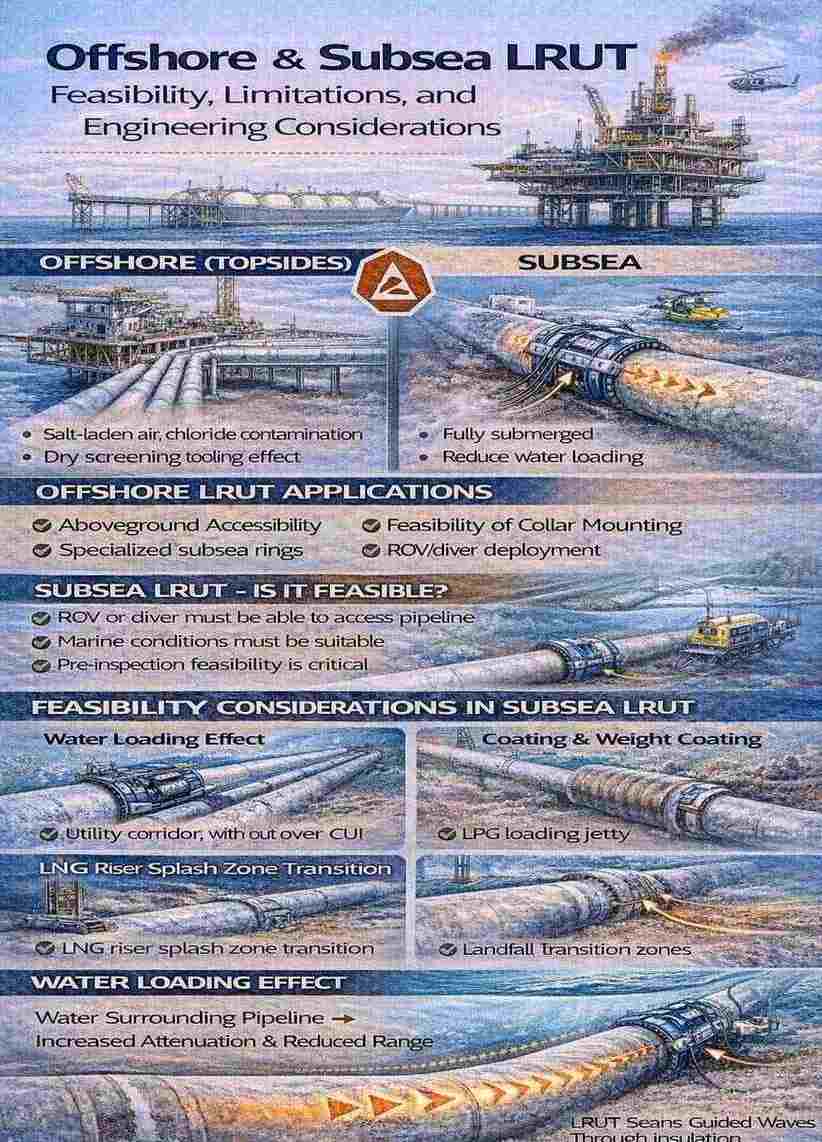
Offshore vs Subsea Understanding the Difference
🔹 Offshore (Topsides)
Refers to pipelines located above water on:
➤ Fixed platforms
➤ FPSOs
➤ Offshore terminals
➤ Marine loading jetties
🔹 Subsea
Refers to pipelines located:
➤ Fully submerged underwater
➤ On seabed
➤ In splash zone transitions
➤ At riser base sections
The engineering approach differs significantly between these two.
Offshore LRUT Applications (Topsides)
Offshore topside pipelines are ideal for LRUT screening due to:
➤ Aboveground accessibility
➤ Controlled installation environment
➤ Reduced water loading effect
➤ Feasibility of collar mounting
Typical offshore topside applications include:
➤ Process pipelines
➤ Utility corridors
➤ Gas transfer lines
➤ Insulated lines (CUI-prone)
➤ Splash-zone adjacent sections
LRUT is highly effective for screening long aboveground offshore pipelines.
Subsea LRUT – Is It Feasible?
Subsea LRUT is technically feasible in certain conditions, but it requires:
➤ Specialized subsea rings
➤ ROV or diver deployment
➤ Topside data acquisition
➤ Pre-inspection feasibility assessment
Subsea LRUT is typically applied to:
➤ Riser approach sections
➤ Accessible subsea flowlines
➤ Tie-in spool pieces
➤ Caisson sections
➤ Landfall transition zones
However, not all subsea pipelines are suitable for guided wave inspection.
Key Engineering Considerations in Subsea LRUT
🔹 Water Loading Effect
Water surrounding the pipe affects guided wave propagation and reduces range.
🔹 Marine Growth
Biofouling increases attenuation and complicates collar installation.
🔹 Coating AND Weight Coating
Heavy coatings reduce signal strength.
🔹 Attachments & Clamps
Subsea structures create complex reflection patterns.
🔹 Access for Collar Installation
ROV or diver access must be feasible.
🔹 Required Inspection Range
Range may be shorter compared to aboveground LRUT.
Feasibility must be evaluated case-by-case.
Limitations of Offshore And Subsea LRUT
Professional transparency is critical.
Offshore Limitations:
➤ Dense pipe rack geometry
➤ Attachment-heavy configurations
➤ Elevated temperature zones
Subsea Limitations:
➤ Signal attenuation due to water loading
➤ Limited range compared to dry environments
➤ Installation constraints
➤ Complex interpretation due to geometry
LRUT remains a screening tool — not a thickness measurement tool.
EMAT vs Piezo in Offshore Applications
Technology selection matters:
➤ Piezoelectric systems are effective for standard offshore topsides.
➤ EMAT systems may be preferable for high-temperature offshore lines.
➤ Subsea systems require specialized collar configurations.
Engineering-led technology selection is critical.
Feasibility Study – The Most Important Step
Before offshore or subsea LRUT deployment:
✔ Conduct attenuation modeling
✔ Assess coating thickness
✔ Evaluate support density
✔ Analyze water loading effect
✔ Confirm access feasibility
✔ Perform engineering range prediction
Without feasibility planning, offshore LRUT may yield inconclusive results.
Best Practice Workflow for Offshore/Subsea LRUT
➤ Engineering feasibility assessment
➤ Technology selection (Piezo or EMAT)
➤ ROV/diver deployment planning (if subsea)
➤ Long-range screening
➤ Indication classification
➤ Targeted verification strategy
➤ Reporting & integrity recommendation
This structured workflow ensures reliable results.
Why Offshore And Subsea LRUT Requires Specialists
Offshore and subsea LRUT is not routine inspection work.
It requires:
➤ Certified Level III engineering oversight
➤ Advanced signal interpretation
➤ Range prediction modeling
➤ Custom collar engineering
➤ Experience in marine environments
➤ Structured reporting methodology
At IAIS India PVT LTD, we provide:
✔ Piezoelectric & EMAT LRUT capability
✔ Subsea feasibility evaluation
✔ Engineering-led signal interpretation
✔ Custom collar engineering (1.5”–72”+)
✔ ISO 9712 Certified personnel
✔ Global offshore mobilization
We function as a Guided Wave Engineering Specialist, not merely an equipment operator.
Conclusion
Offshore and subsea LRUT can be highly effective when applied correctly.
➤ Offshore topside LRUT is widely practical and valuable.
➤ Subsea LRUT is feasibility-dependent and requires engineering evaluation.
Understanding limitations and planning accordingly ensures reliable, safe, and cost-effective inspection outcomes.
🌍 Contact Us – Your Global Pipeline Integrity Partner
IAIS India PVT LTD
Specialists in Long Range Ultrasonic Testing (LRUT) & Guided Wave Pipeline Inspection
📍 Headquartered in India | UAE Operational Support | 🌎 Worldwide Deployment
📧 i@iaisindia.com
Speak with our LRUT engineering team to evaluate offshore or subsea feasibility for your pipeline systems.